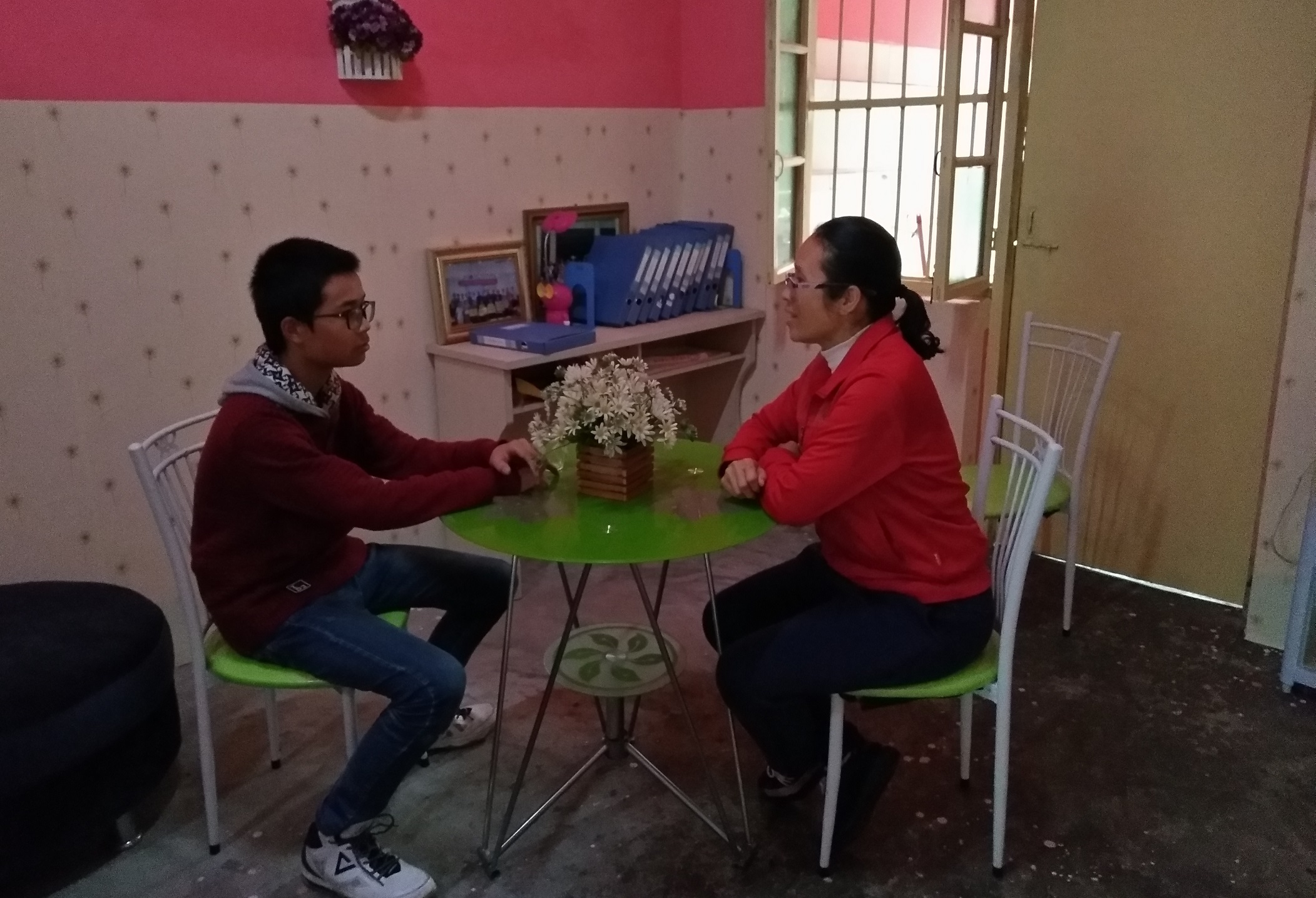
“The Sunny House” — An Emotion Adjustment Space for Left-behind Children
“The Sunny House” is located in a secondary school in a remote mountainous area of Mashan County, Nanning City, Guangxi Zhuang Autonomous Region. 16-year-old Xiao Wen once was a 9th grader at the school. She lives with her mother and uncle.
“My mother has never told me where my dad is”, she said.
The absence of paternal love resulted in Xiao Wen’s lack of sense of security and being defensive about the surroundings. She befriended a young man outside her school, calling him “big brother”. Whenever she had conflicts with classmates, she turned to the “big brother” who resolved the conflicts with violence.
Last year, the Supreme and Local Procuratorates of Guangxi arrested 53 and sued 70 persons on charges of school bullying and violent crimes. A total of 163 juvenile delinquents were put under reformatory. Left-behind children were found more likely to involve in violence due to their mental status.
Xiao Wen’s school since 2010, in collaboration with World Vision and the County Education Bureau, organized 15 teachers to receive training on rural primary and secondary school students’ mental health. World Vision also organized school leaders and faculty to visit other schools to learn about best practices in mental health education and how counselling rooms operate. In addition, experts were invited to share their experiences with the school and provide guidance. With the help of the County Education Bureau and World Vision, “the Sunny House”, a counselling project, was established in 2011, housing 8 part-time professionally trained mental health counsellors.
“The Sunny House” is opened to students from Monday through Thursday. Leveraging other educational activities, the school promoted the functions of the counselling room, changing students’ mindset to destigmatize counselling.
When Xiao Wen was about to enter high school, she turned to “the Sunny House” to help resolve a conflict with a male student in her class. She wanted to take revenge on him, but was hesitant since serious violation record would give a bad impression when she enters high school.
The counsellor listened to Xiao Wen carefully, before telling her that her hesitation and concern meant goodness in her heart. Then she explained patiently the potential negative impact of Xiao Wen’s rash action. In the end, Xiao Wen gave up the thought of revenge. “I felt relieved after talking out my problems with the counsellor,” she said. “Her patience in listening and persuasion carried my anger away.”
“The Sunny House” has provided psychological counselling to 200 students since its opening, most of whom took the initiative. Xiao Wen says, “I will resolve conflicts with classmates peacefully. I don’t want my mother to worry about me.” Even after graduation in July 2016, she often goes back to visit her counsellor.
(Written by Liao Haizhen)